
Fort Myers, FL · Garage Door Service
When the Power Goes Out, What Happens to Your Garage Door Opener
Fort Myers openers and power outages: why 1970-2006 housing stock and mild coastal humidity change how your opener fails and what to check before you call anyone.
- Repairs & new doors
- Springs & openers
- Serving 7 nearby communities
What the Weather Here Does to It
Fort Myers sits in a mild temperate band, so you're not dealing with freeze-thaw cycles that crack belts or stiffen grease the way colder markets do. What you are dealing with is humidity and heat working on electronics year-round. Circuit boards in openers installed decades ago weren't built with the sealed, moisture-resistant housings that newer units have, and that matters here more than in a dry climate, because condensation inside a logic board enclosure corrodes contacts slowly over years rather than failing all at once.
Most houses in this area went up between 1970 and 2006, with the typical build year landing around 1986. An opener installed when that house was built, or even a replacement unit from the 1990s, is older technology than what's sold today - no battery backup, no rolling code security, sometimes no safety reversal sensors at all. When the power outages, whether from a grid issue or a breaker trip, these older units don't fail gracefully. They just stop, mid-cycle if you're unlucky, and the door is wherever it was when the power left.
Heat does its own quiet damage too - it dries out chain lubricant faster and can warp plastic drive gears in units that have sat in an unconditioned garage for fifteen-plus years.
Checking It Yourself
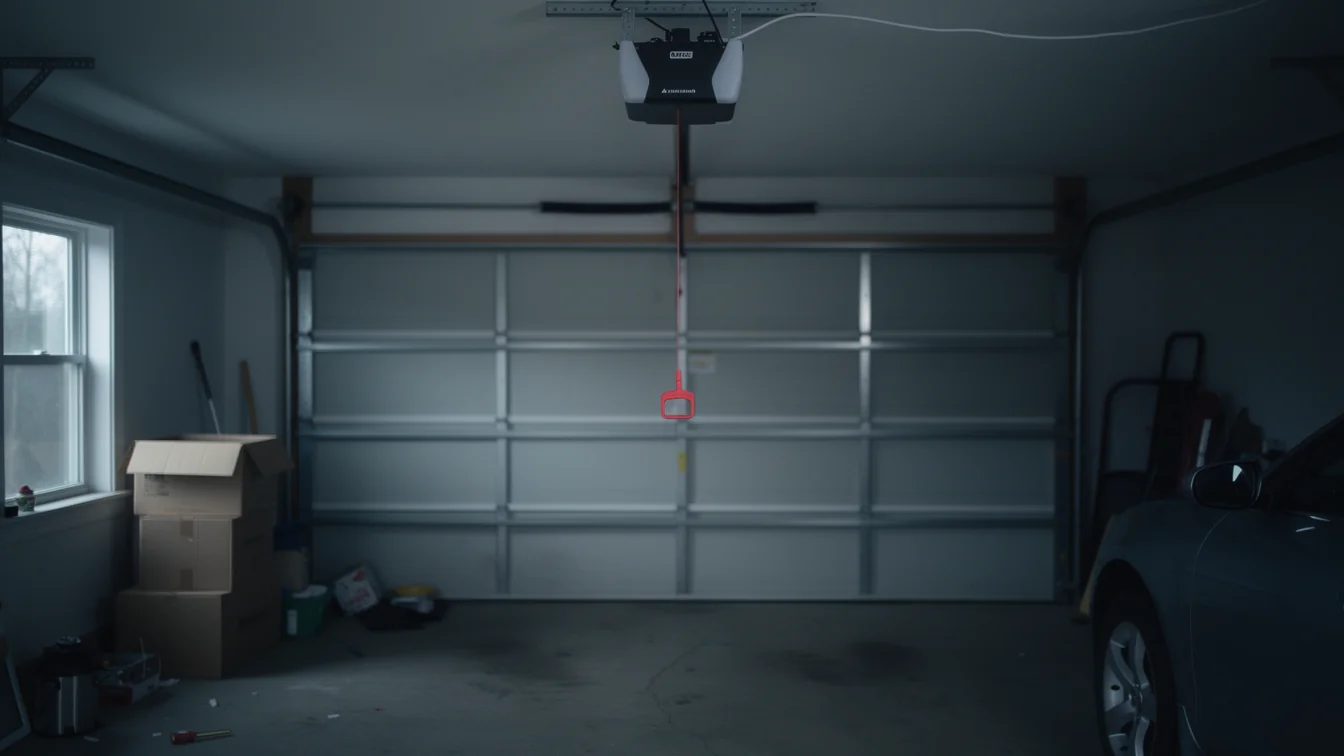
First, find the manual release cord - the red handle hanging from the trolley on the rail. Pull it straight down (not at an angle) and the door should separate from the opener carriage, letting you lift it by hand. If you can't find this cord, or it's been painted over or tied up out of reach, that's worth fixing before you ever lose power, not during.
Second, check whether your opener has a battery backup box - a separate unit, usually white or gray, mounted near the motor head. If your house was built in the 1970s through the 1990s and the opener hasn't been replaced, odds are good it doesn't have one. No backup means no automatic operation during an outage, full stop.
Third, test the door's balance by disconnecting the opener and lifting the door halfway by hand. It should stay roughly in place. If it crashes down or springs up, the issue isn't the opener or the power - it's the spring, and that's a separate problem from anything an outage will cause.
If your income allows for it, a battery backup opener is a reasonable upgrade for a market where outages happen; at the area's median household income of $81,830, it's a modest expense most owners here can plan for rather than an emergency buy.
What Most People Get Wrong
The most common mistake is assuming a dead opener after a power outage means a broken opener. Nine times out of ten, nothing is broken - the unit just has no power and, if it's an older install, no battery to fall back on. People call a repair line in a panic when what they actually need is the manual release cord and a few minutes of lifting by hand.
The second mistake is forgetting to re-engage the opener properly once power returns. Pull the release cord back toward the motor (or follow the reconnect steps on your model) before you try the remote again, or the trolley won't catch the door and you'll think the opener itself failed.
The third mistake is bigger: treating an opener from the 1986-era housing stock the same as one from last year. Across the 22 named communities in this service area, most garages still run openers original to or close to the home's construction. These units weren't designed with the battery backup and smart-sensor standards common now, and expecting modern behavior from thirty-year-old hardware during a power event sets you up for disappointment, not a diagnosis.
The Problem
Here's the actual mechanical problem: a garage door opener motor needs continuous power to run its drive, and without a battery backup, a power outage simply halts it wherever it is in the cycle. That's it. There's no fault code, no part to replace, no damage done in most cases. The door is just disconnected from automatic control until power returns or until you use the manual release.
The complication specific to this area is how many openers were installed during the long 1970-2006 building run, with a concentration around the mid-1980s, before battery backup was standard equipment. A newer opener bought today almost always includes one. An opener original to a house built in 1986 almost never does.
One limitation worth stating plainly: a battery backup unit is not something that gets added to an existing motor head in most cases - it typically requires replacing the opener itself, not bolting an accessory onto the old one. If your current unit doesn't have a built-in backup slot, the honest fix is a new opener, not a retrofit kit, and that's a bigger decision than most people expect going in.
Frequently asked questions
Will my garage door opener work during a power outage?
Only if it has a battery backup unit built in. Many openers installed in houses built in this area's typical 1970-2006 range, especially around the mid-1980s median, don't have one. Without backup power, the motor simply stops and the door stays wherever it was when power outage out until you use the manual release cord.
How do I open my garage door by hand during a power outage?
Find the red release cord hanging from the trolley on the rail inside your garage and pull it straight down. This disconnects the door from the opener carriage so you can lift it manually. Once power returns, reconnect the trolley following your model's instructions before using the remote again.
Does Fort Myers humidity affect garage door openers?
Yes, gradually. The mild, humid climate here doesn't crack hardware the way freeze-thaw cycles do elsewhere, but moisture can corrode circuit board contacts over years, especially in openers original to older homes that lack sealed housings. It's slow damage, not sudden failure, which is why it often goes unnoticed until the unit stops responding.
Is it worth upgrading to a battery backup opener?
For a lot of owners in this area, yes - it's a reasonable one-time expense rather than an emergency purchase, particularly given the area's median household income. But it usually means replacing the whole opener, not adding a part to your existing one, so it's a bigger decision than a quick repair.
Related garage door services in Fort Myers
More garage door guides
Book garage door service in Fort Myers
Call now or request a quote - tell us what the door is doing and where you are.