Fort Myers, FL · Garage Door Service
Is Your Fort Myers Garage Door Worth Fixing or Should It Go
A look at when a 1980s-90s Fort Myers garage door is worth repairing versus replacing, based on the area's housing stock and mild coastal climate.
- Repairs & new doors
- Springs & openers
- Serving 7 nearby communities
What the Weather Here Does to It
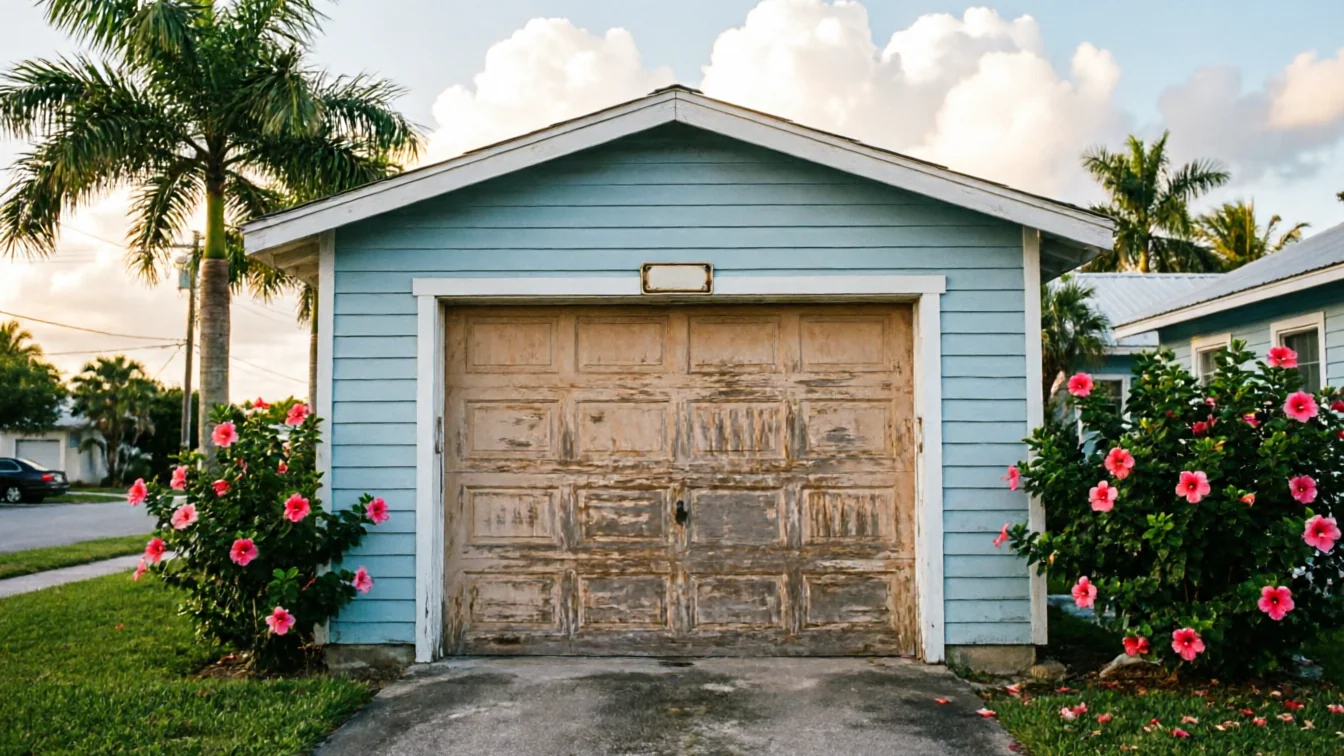
Most houses across this service area went up between 1970 and 2006, with the median landing around 1986. That means a lot of doors and openers still running are from that build era, and they've spent three or four decades in a mild temperate climate rather than a cold one. The upside is real: you don't get the frost heave or deep freeze-thaw cycling that cracks concrete aprons and warps tracks up north. The downside is just as real. Humidity and salt-laden air off the Gulf corrode galvanized coatings on hinges, rollers, and track bolts steadily, year-round, with no winter break to slow it down. In neighborhoods like Eastwood Village, Winkler, and Colonial Country Club, where the housing stock runs 1980s and 90s, the galvanized coating on hinges and tracks is often the first thing to go, even when the panels themselves still look fine. Rust doesn't announce itself with a single storm here - it's a slow, constant process. That changes what "worth fixing" means: the door panel can outlast the hardware holding it up by twenty years.
Checking It Yourself
Open the door by hand with the opener disconnected and watch the springs and cables, not the panel. On a door built around that 1986 median year, the torsion spring hardware is often original, but the cable drums and rollers usually aren't - they get swapped out once or twice over a 35-plus year life. Look for orange-brown rust bloom at the spring coils and the track brackets, not just surface dust. Run your hand along the bottom roller track and feel for pitting; in this climate, pitted steel means the galvanizing failed years ago and the base metal has been corroding since. Check the bottom seal too - mild winters here don't force owners to replace it on a schedule, so it often goes until it's visibly cracked or leaking water under the door during a heavy rain. None of this tells you whether to replace the whole unit, but it tells you whether the hardware failure is isolated or systemic. One rusted roller is a $15 part. Rust on every roller, the track brackets, and the spring coils together is a different conversation.
What Most People Get Wrong
The common mistake is judging the door by the panel. A steel panel from the 1980s or 90s holds up fine in this climate - it's not getting hammered by hail or snow load, and the mild temperate band here is easy on sheet steel. People see a straight, unblemished panel and assume the whole unit is fine, then get surprised when a spring snaps or a track bracket pulls loose from rusted-through sheet metal. The other mistake is assuming age alone means replace. With 39,416 owner-occupied houses across the service area and a median household income of $81,830, plenty of owners here are deciding whether to spend around $300 on a tune-up or $1,200-plus on new tracks, drums, and an opener. That decision should be based on what's actually failing - hardware corrosion, worn rollers, a tired opener motor - not the build date on its own. A door can be 35 years old and mechanically sound if it's been kept lubricated and the hardware was swapped at the first sign of rust instead of the third.
The Problem
Here's the honest limit: once rust has gotten into the track brackets where they bolt to the framing, or into the spring anchor bracket itself, we don't patch that. Those parts carry load, and a corroded anchor point is a safety call, not a maintenance one - it gets replaced, full stop. If that corrosion has spread to the point where three or four structural brackets need replacing on a door that's also due for new cables, drums, and rollers, you're close enough to the cost of a new door and opener that fixing it piece by piece stops making sense. A door from the 1986 median build year in this area usually still has its original torsion spring hardware, just not the matching cable drums anymore, and that mismatch alone is sometimes enough to tip the math toward replacement rather than another round of parts.
Frequently asked questions
How often should I check my garage door hardware living this close to the Gulf?
Given the mild temperate climate here and the corrosion it causes rather than cold-weather cracking, check rollers, hinges, and track brackets for rust at least twice a year. Humidity and salt air work on exposed steel continuously, not just during storm season, so a once-a-year glance often misses early pitting that's already underway.
My door is from the 1980s. Is that too old to fix?
Not on its own. Houses across this area median out around 1986, and plenty of those original doors still run fine if the hardware's been kept ahead of rust. Age tells you to inspect closely, not to replace automatically. What matters is whether the springs, cables, and brackets are corroded or just the coating is worn.
Why does my opener motor seem to wear out faster than friends' up north?
We don't have data on opener lifespan specifically, so we can't say motors here fail faster for climate reasons. What we do know is the mild temperate band means no deep-freeze stress on the unit, so if a motor's struggling, it's usually age, worn gears, or a door that's gotten heavier to lift due to track or roller friction.
Related garage door services in Fort Myers
More garage door guides
Book garage door service in Fort Myers
Call now or request a quote - tell us what the door is doing and where you are.