
Fort Myers, FL · Garage Door Service
Why Your Garage Door Keeps Jumping the Track
A look at why Fort Myers garage doors slip off track, tied to 1970-2006 tract housing stock and a mild temperate climate without freeze-thaw cycling.
- Repairs & new doors
- Springs & openers
- Serving 7 nearby communities
What the Weather Here Does to It
Fort Myers sits in a mild temperate band, which means you skip the freeze-thaw cycling that cracks slab footings and twists frames in colder parts of the country. That's the good news. The catch is that mild doesn't mean static. Metal track expands and contracts through the day even without hard frost, and over enough years that daily movement works roller brackets loose and shifts the vertical track a few degrees out of plumb. You won't see it happen. You'll just notice the door start to bind on one side, or a roller grinding where it used to roll quiet.
Because there's no freeze line to worry about, most of these houses were built with garage slabs poured flush and tracks bolted straight to wood jambs rather than engineered for seasonal shift. That was fine for the first couple decades. On a door pushing thirty-plus years of that daily thermal flex, the lag bolts holding the track brackets back out a little at a time. A door that's slightly off track in a mild climate is almost always a hardware fatigue problem, not a weather-event problem - there's no storm or freeze to blame it on, just time.
Checking It Yourself
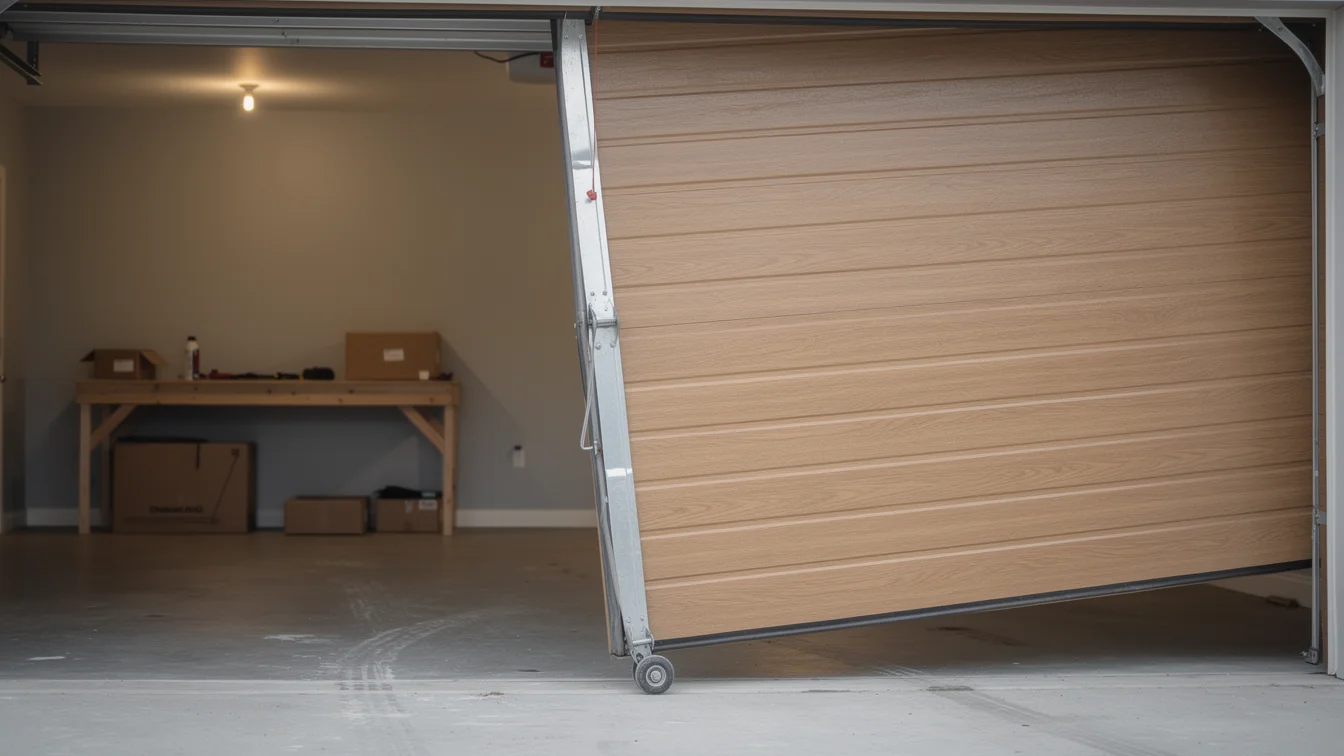
Walk the track with a flashlight before you call anyone. Look at the horizontal track sections near the back of the garage - on houses built in that 1970-2006 run, those are usually bolted to framing that's original to the house, never touched since. Check for daylight between the bracket and the stud, or a bracket that rocks when you push on it. That's the track pulling away, and it's the number one reason a door jumps rail on the opening or closing swing.
Next, look at the bottom rollers where the track curves from vertical to horizontal. If the roller stem is bent or the roller itself is worn oval instead of round, the door will ride up out of the track right at that curve. On houses from the 1980s and 90s stock common across this area, those original rollers are usually the galvanized steel kind that wears a groove into itself over time rather than the nylon rollers used in later retrofits.
One limitation worth saying up front: if the track itself is bent rather than just loose, straightening it almost never holds. A bent track needs replacing, not bending back - we won't tell you otherwise just to save a trip.
What Most People Get Wrong
The most common mistake is assuming a door off its track is a spring problem. It's usually not. Springs lift and lower the door; the track is what keeps it moving in a straight line. You can have a perfectly good spring and still have a door that walks off the rail because a bracket backed out or a roller failed.
The second mistake, common in this part of Florida given how much of the housing stock here dates to the 1970-2006 building wave, is treating the original hardware as permanent. A track bracket lag-bolted into a door jamb in 1986 was built to the code and expectations of 1986. It wasn't designed to still be carrying a door's full weight forty years later. People tighten the bolts, the door runs fine for a few months, and it comes loose again because the wood around the old bolt holes is chewed up and won't hold a fastener anymore.
Third, people try to force a door back onto the track by hand with the opener still powered. That's how door panels get dented and how fingers get hurt. Disconnect the opener first, every time.
The Problem
Across the neighborhoods closest in - Tice, Whiskey Creek, Lochmoor Waterway Estates, Winkler, Eastwood Village - most garages were built during that same 1970-2006 stretch, with the bulk of it landing in the 1980s and 90s. That means a lot of doors out there are running on track hardware that's original to the house: steel brackets, steel rollers, lag bolts into softwood framing that's had thirty-plus years of door-weight stress and daily thermal expansion working against it, even without a harsh winter to blame.
With roughly 82,686 households and 39,416 owner-occupied houses across the service area, a meaningful share of those garages are at or past the point where the original track hardware is simply worn out rather than damaged by any one event. That's a different repair than what you'd plan for in a region with hard freezes and storm-driven damage - here it's slow fatigue, not sudden failure, and it shows up as a door that drifts off track a little more each month until one day it doesn't close straight at all.
A track reset without replacing the worn brackets and rollers underneath it is a short-term fix. If the hardware's original to a house built in the 80s, it's due, not just due for an adjustment.
Frequently asked questions
Why does my garage door only jump the track on one side?
Usually it means the bracket or roller on that side has failed first, not both at once. Check the lag bolts holding that side's vertical track to the jamb - on older houses here, the wood around those holes often doesn't hold a fastener anymore, so the track leans a few degrees and the roller rides up and out.
Is a bent track something I can fix myself?
Straightening a bent track rarely holds for long - the metal has a memory and tends to kink again at the same spot. If the track is actually bent rather than just loose at the brackets, plan on replacing that section instead of forcing it back into shape.
Does Fort Myers weather cause this, since there's no winter?
Not in the way winter does elsewhere. You don't get the freeze-thaw cracking that racks frames up north, but daily heat expansion still works bolts and brackets loose over decades. On a door built in the 80s or 90s, it's cumulative wear, not a storm or a cold snap, that eventually lets the track pull away.
How old does track hardware have to be before it's worn out, not just loose?
There's no fixed year, but houses built in the 1970-2006 range common here are carrying original steel brackets and rollers that were never meant to run thirty-plus years under daily door weight. If tightening the bolts stops holding within a few months, the wood or the hardware itself is worn past the point of a quick fix.
Related garage door services in Fort Myers
More garage door guides
Book garage door service in Fort Myers
Call now or request a quote - tell us what the door is doing and where you are.